
Protecting a commercial property involves more than installing a fence around its boundary. Warehouses, factories, logistics yards and business premises often contain valuable equipment, stock and infrastructure that require reliable perimeter protection. A well-designed security fence can help discourage unauthorised access while clearly defining restricted areas.
For properties where preventing climbing is a major concern, palisade security fencing is one of the options worth considering. Its vertical steel pale construction, robust framework and limited footholds make it suitable for many industrial and commercial applications. However, the best anti-climb fence depends on the property’s security risks, location, access requirements and budget.
Understanding how different fencing systems perform can help business owners and facility managers make a more informed decision.
What Makes a Commercial Fence Difficult to Climb?
An anti-climb fence is designed to make scaling a perimeter barrier more difficult. Unlike standard boundary fencing, it focuses on limiting accessible handholds and footholds while maintaining the structural strength needed for commercial environments.
Several features influence how effectively a fence discourages climbing:
- Fence height: A taller barrier can make unauthorised access more difficult, provided the design complies with applicable requirements.
- Vertical construction: Closely considered vertical profiles can reduce the number of convenient climbing points.
- Limited footholds: Designs that minimise horizontal surfaces make it harder to gain traction.
- Strong materials: Steel fencing systems can provide durable perimeter protection when appropriately specified.
- Secure fixings: Suitable connections and tamper-resistant components can reduce opportunities to loosen or remove sections.
- Gate security: Gates, hinges, locks and access-control equipment should provide protection consistent with the adjoining fence.
These elements work together. A tall fence with poorly secured gates or nearby structures that provide climbing access may still leave a property vulnerable.
The objective is not to create a fence that can never be climbed, but to select a system that provides an appropriate level of deterrence for the site.
Which Types of Anti-Climb Fencing Are Best for Commercial Properties?
Different commercial properties face different security challenges. A warehouse storing expensive machinery may require a stronger perimeter barrier than an office complex where appearance and pedestrian visibility are equally important.
Three fencing systems are particularly useful to understand when comparing commercial security options.
1. Palisade Fencing for Higher-Security Commercial Sites
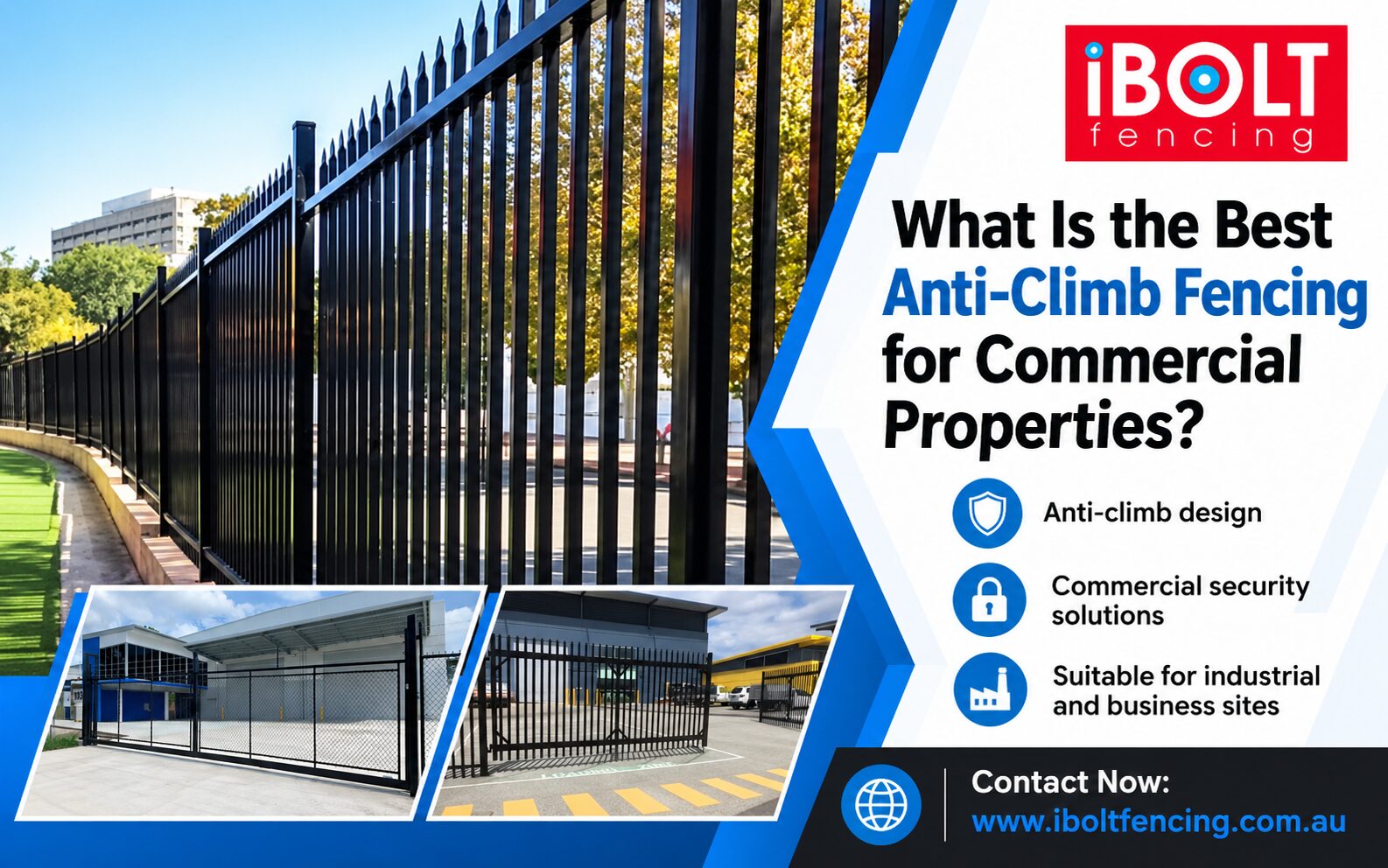
Palisade fencing uses vertical steel pales attached to horizontal rails and supporting posts. Its design creates a substantial physical barrier while limiting convenient footholds.
The shape and construction of the pales contribute to the fence’s security performance. W-section and V-section profiles are commonly available, with different specifications suited to different applications.
Palisade fencing can be considered for:
- Manufacturing facilities and industrial compounds.
- Warehouses storing valuable equipment.
- Transport and logistics yards.
- Utility facilities and restricted-access areas.
- Commercial properties require substantial perimeter protection.
One advantage is its adaptability. Fence height, pale profiles, spacing, finishes and fixings can be specified according to the requirements of a particular property.
Galvanised steel and suitable protective coatings can also improve durability in outdoor environments.
However, palisade fencing should not automatically be treated as the best solution for every property. Its appearance, top profile, surrounding environment and intended users should also be considered.
2. Garrison Fencing for Security and Professional Appearance
Some commercial properties need effective boundary protection without creating an excessively industrial appearance.
This is where garrison fencing can be a practical choice.
It generally features vertical tubular steel pickets attached to horizontal rails, providing a clear boundary while allowing visibility through the fence.
Depending on its design and specifications, garrison fencing can discourage casual climbing and unauthorised entry.
It is commonly considered for commercial premises, schools, office buildings, car parks and public-facing facilities.
A key consideration is the arrangement of its rails and pickets. Exposed horizontal rails may provide climbing opportunities, so the design should be assessed rather than assuming every garrison fence offers the same resistance.
For businesses that want a balance between security, visibility and architectural appearance, a properly specified garrison system may be more suitable than a heavy-duty industrial barrier.
3. Welded Mesh Fencing for Limited Handholds
Specialised welded mesh fencing is another option for properties where climb resistance is an important consideration.
One commonly discussed configuration is 358 mesh, which uses small rectangular apertures that make it difficult to obtain convenient finger and toe holds.
The mesh panel is attached to supporting posts using suitable fixings to form a continuous perimeter barrier.
Potential applications include infrastructure sites, restricted compounds and facilities that require visibility through the fence.
The performance of a mesh system depends on factors including wire diameter, aperture dimensions, panel height, fixing design and installation quality.
Standard chain mesh fencing should not be confused with purpose-designed anti-climb welded mesh. Conventional chain mesh has larger openings that can provide footholds, unless additional security measures are incorporated.
Palisade vs Garrison vs Mesh Fencing: Which Should You Choose?
There is no single fencing product that suits every commercial environment. The most appropriate choice depends on the property’s risk profile and the security objectives of the installation.
The following comparison highlights the main differences.
| Feature | Palisade fencing | Garrison fencing | Specialised welded mesh |
| Main construction | Profiled vertical steel pales | Vertical tubular steel pickets | Closely spaced welded wires |
| Climb deterrence | Strong potential with suitable profiles and design | Design-dependent | Strong potential with small apertures |
| Visibility | Generally good | Generally good | Generally good |
| Appearance | Industrial and security-focused | Architectural and professional | Functional and security-focused |
| Common applications | Industrial yards, utilities, warehouses | Offices, schools, car parks | Restricted sites, infrastructure |
| Key consideration | Pale profile and fixings | Rail arrangement and picket spacing | Aperture size and panel connections |
Palisade fencing may be the preferred option where a substantial industrial security barrier is required.
Garrison fencing may be appropriate where controlled access, visibility and presentation are important.
For a more detailed comparison of these two popular security fencing systems, read our guide on Choosing Between Palisade and Garrison Fencing: Which Is Right for You?. It explores the differences between both fencing options to help commercial property owners understand which solution may better suit their security requirements, site conditions and property design.
Specialised welded mesh may suit sites where reducing potential handholds and footholds is a primary design objective.
A professional site assessment is the most reliable way to determine which system meets the property’s actual requirements.
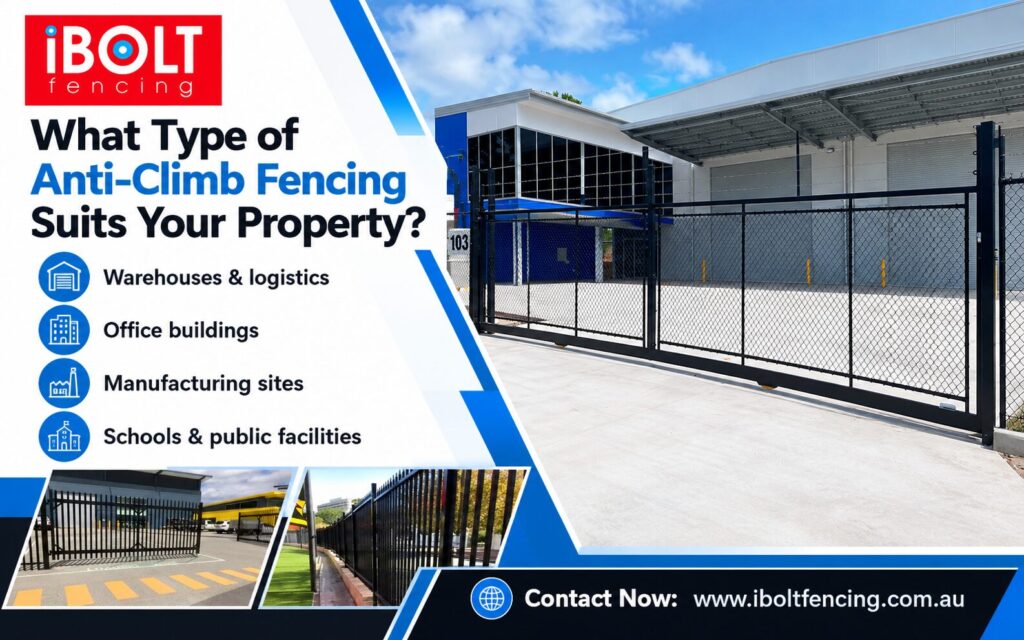
What Type of Anti-Climb Fencing Suits Your Property?
Choosing a security fence becomes easier when you consider how the property operates and where unauthorised access is most likely to occur.
Warehouses and Logistics Facilities
Warehouses often have multiple vehicle access points, loading areas and outdoor storage spaces.
Security planning should account for delivery schedules, after-hours access, valuable inventory and the movement of large vehicles.
Palisade fencing may suit exposed storage yards and boundaries where stronger deterrence is needed. Gate widths, access control and visibility around entrances also require attention.
Office Buildings and Commercial Complexes
Office premises generally need a balance between security and a welcoming appearance.
For these sites, garrison security fencing can provide a defined perimeter while maintaining visibility and a professional finish.
The right design should consider entrances, pedestrian pathways, vehicle parking, emergency access and the surrounding architecture.
Manufacturing and Industrial Properties
Factories may contain expensive machinery, hazardous operational areas and materials stored outdoors.
Their security needs can extend beyond theft prevention to include keeping unauthorised visitors away from restricted operational zones.
Industrial fencing should be selected based on the sensitivity of the site, potential risks and the required level of access control.
Schools and Public-Facing Facilities
Schools and community facilities have additional considerations because children, staff and visitors regularly use the premises.
Fence design must balance controlled access, visibility and user safety.
Suitable heights, safe top profiles, compliant gates and relevant project specifications should be considered before selecting a system.
A fencing design that is appropriate for an industrial yard may not be appropriate for an area used by children.
What Should You Check Before Installing Anti-Climb Fencing?
Selecting the product is only one part of the process. Even a well-designed fence can underperform when site conditions and installation requirements are overlooked.
Assess the Security Risks
Start by identifying what the fence needs to protect.
Consider whether the primary concern is trespassing, theft, vandalism, access to hazardous areas or after-hours security.
These risks influence the required fence design and whether other measures, such as CCTV or monitored access control, may be useful.
Review the Surrounding Environment
Nearby walls, stored materials, trees and other structures can affect perimeter security.
For example, items positioned beside the fence may create opportunities to bypass its anti-climb features.
The boundary should therefore be evaluated as a complete environment, not simply as a line where fence panels will be installed.
Choose an Appropriate Height
Fence height influences deterrence, but taller is not always automatically better.
The appropriate height depends on site risk, local planning requirements, visibility, safety and the selected fencing system.
Before installation, confirm any relevant local government approvals, property boundary conditions and applicable project specifications.
Consider Perth’s Environmental Conditions
Fencing installed in Perth may experience strong sunlight, seasonal rain and, in coastal locations, increased exposure to salt-laden air.
Galvanising, powder coating and suitable material specifications can help protect steel components against corrosion.
The coating system should be selected with the site’s exposure conditions and maintenance expectations in mind.
Plan Gates and Access Points
A security fence is only as effective as the perimeter it creates.
Poorly positioned gates, unsuitable locks and gaps around access points can undermine the intended protection.
Swing gates, sliding gates and automated access systems should be considered alongside the fence design, particularly for sites with regular vehicle movements.
How Much Does Anti-Climb Fencing Cost in Perth?
The cost of anti-climb fencing varies according to the selected system, materials, installation conditions and security requirements.
Instead of relying on a general price per meter, commercial buyers should evaluate the factors that influence the complete project.
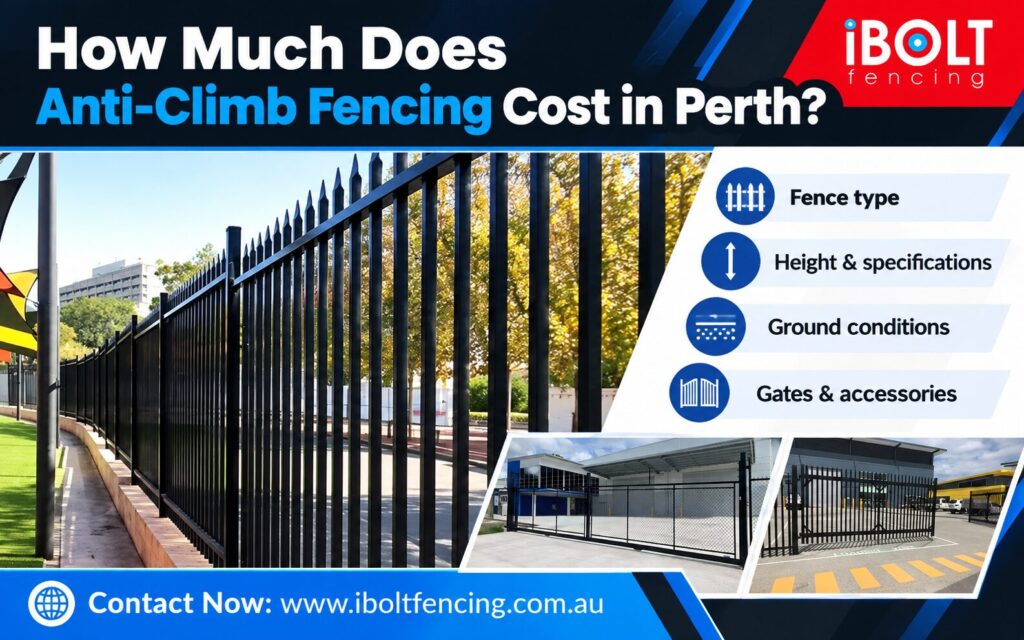
These commonly include:
- Fence type: Palisade, garrison and specialised mesh systems have different material and fabrication requirements.
- Height and specifications: Taller fencing, heavier sections and specialised components may increase costs.
- Total boundary length: Project size affects material quantities and installation planning.
- Ground conditions: Sloping terrain, existing concrete, underground services and difficult access can influence installation methods.
- Protective finishes: Coating requirements may vary according to exposure and project specifications.
- Gates and accessories: Vehicle gates, pedestrian gates, locks and automation add to the overall scope.
Two properties with the same boundary length may require different budgets because their installation conditions and security objectives are different.
For an accurate comparison, request a site-specific quotation that clearly identifies the fencing materials, installation scope, gate requirements and any exclusions.
How Can iBOLT Fencing Help Secure Your Commercial Property?
Commercial perimeter fencing requires careful planning to ensure the installed system suits both the site’s security objectives and its daily operations.
iBOLT Fencing provides fencing solutions for commercial and industrial properties across Perth and Western Australia, including palisade, garrison and other perimeter fencing systems.
Whether a project involves an industrial storage yard, warehouse boundary or commercial development, selecting an appropriate design starts with understanding the site.
Businesses looking for commercial fencing perth solutions can contact iBOLT Fencing to discuss their property’s layout, security priorities and installation requirements.
An informed consultation can help establish suitable fencing options, gate configurations, material finishes and project specifications before work begins.
Frequently Asked Questions About Anti-Climb Fencing
What is the best anti-climb fencing for commercial properties?
The best option depends on the required security level and the property’s layout. Palisade fencing is often considered for industrial perimeters, while specialised welded mesh can help limit handholds and footholds. Garrison fencing may suit sites where appearance, visibility and controlled access are important.
Is palisade fencing difficult to climb?
A properly designed palisade fence can make climbing more difficult because of its vertical steel profiles and limited footholds. Performance depends on the fence height, pale arrangement, fixings and surrounding conditions. No fencing system should be considered completely impossible to climb.
Is garrison fencing suitable for commercial security?
Yes. Garrison fencing can be suitable for offices, schools, car parks and commercial properties requiring a defined, durable boundary. Its climb resistance depends on the particular design, including rail placement, picket spacing, height and installation quality.
What height should anti-climb fencing be?
There is no single height suitable for every commercial property. The decision should account for the site’s risk assessment, local requirements, fence construction and surrounding environment. A qualified fencing contractor can help determine an appropriate specification for the proposed installation.
Can anti-climb fencing be installed with automatic gates?
Yes. Security fencing can be combined with suitable swing or sliding gate systems, including automated options where appropriate. The gate design, locking arrangements, safety devices and access-control equipment should be planned as part of the overall perimeter security system.
Does anti-climb fencing require regular maintenance?
Steel security fencing generally benefits from periodic inspections. Check for damaged coatings, corrosion, loose fixings, ground movement and issues with gates or locks. Maintenance requirements depend on the fencing material, protective finish, environment and frequency of use.
Conclusion
The best anti-climb fencing for a commercial property is the system that addresses its specific security risks without compromising practical access, safety or long-term durability.
Palisade fencing offers a substantial barrier for many industrial applications, garrison fencing can provide a combination of perimeter protection and professional appearance, and specialised welded mesh can be useful where restricting footholds is a key concern.
Before making a decision, consider the property’s layout, expected security performance, environmental exposure and access requirements. A properly specified and professionally installed perimeter system can provide a stronger foundation for protecting commercial premises over the long term.